This post contains affiliate links, which means I may earn a small commission at no cost to you if you purchase through them. I only recommend products I genuinely use and believe in. Nothing in this post is medical advice — always check with your doctor before starting a new supplement.
The supplement aisle is a scam.
Not all of it. But most of it.
If you walked into Whole Foods or scrolled Amazon for ten minutes, you'd come out thinking you need 23 different bottles to function as a woman over 40. Collagen for your skin. Adaptogens for your stress. Greens powder for your gut. Hair, skin, and nails gummies for the photos. Sleep capsules for the 3 a.m. wake-up. Hormone balance blends with names like "Goddess" and "Bloom" and "Reset."
Most of it doesn't do anything.
Some of it actively wastes your money.
A small handful of supplements actually move the needle for women over 40 — and once you know which ones they are, you can stop spending $200 a month on shelves full of pretty bottles and start spending $40 a month on the ones that do the job.
This is what actually works. And what to stop buying immediately.
Why most "women over 40" supplements are nonsense
Here's the trick of the supplement industry, and once you see it, you can't unsee it:
The same six or seven ingredients show up in nearly every supplement marketed to women in midlife. They get repackaged into different blends, slapped with different feminine-coded names, and sold at three to five times the price of the individual ingredient.
A single bottle of "hormone harmony" supplement is usually:
- A small dose of magnesium
- A small dose of B vitamins
- A small dose of one or two adaptogens
- Filler
- A premium for the branding
You could buy magnesium glycinate and a B-complex separately for half the price, get higher doses, and have full control over what you're taking and when.
The same is true for "sleep" blends, "stress" blends, "menopause" blends, and most "anti-aging" blends. They're rarely better than the individual ingredients. They're almost always more expensive.
The good news: once you know what actually works, your supplement routine gets simpler — and cheaper.
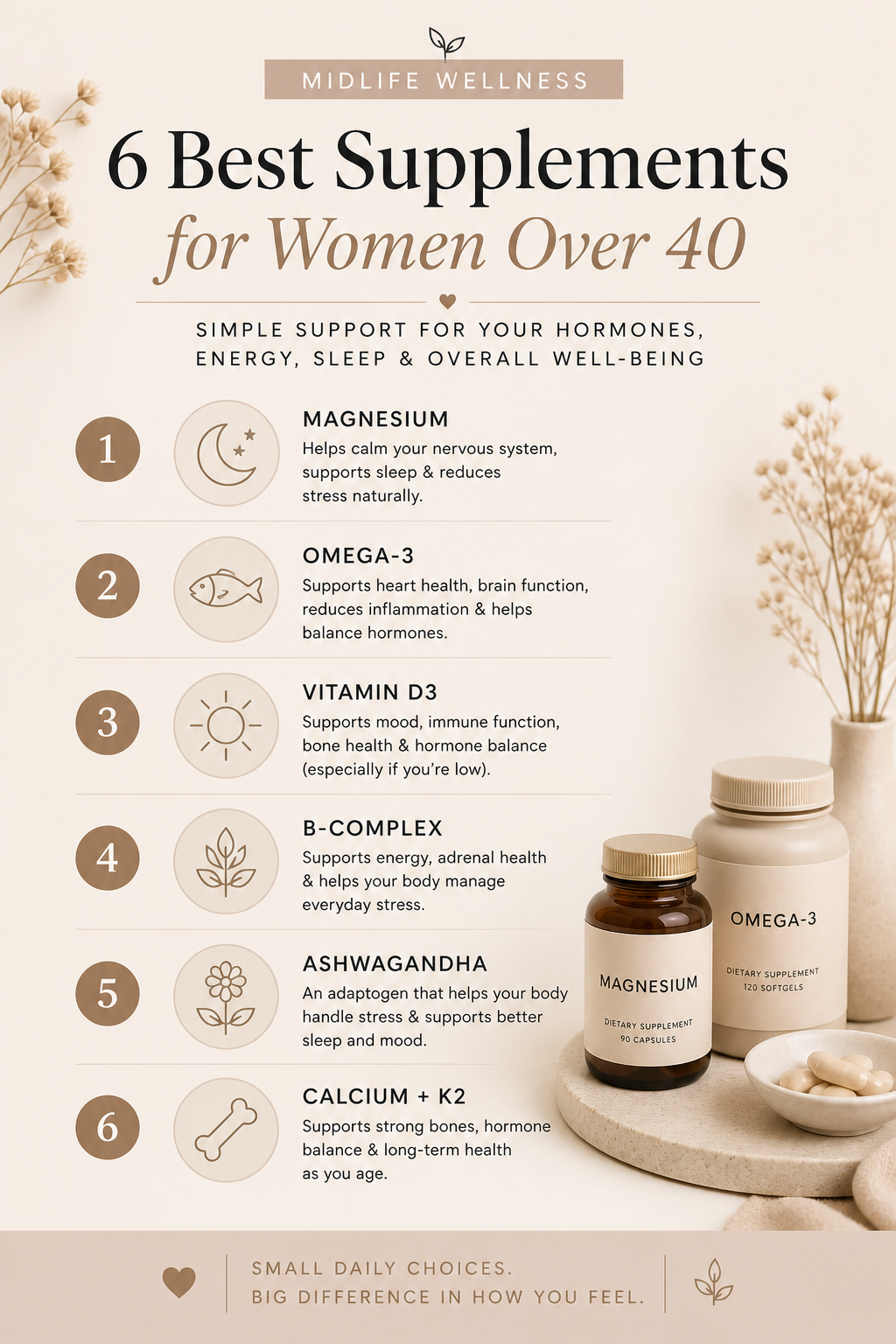
The 6 supplements that actually work for women over 40
These are the ones with real evidence, real impact, and a meaningful effect on how you feel. In order of how much they move the needle.
1. Magnesium glycinate
If I could only recommend one supplement to a woman over 40, this would be it.
Magnesium is involved in over 300 processes in your body, including the ones that regulate sleep, calm the nervous system, support muscle recovery, and help your body produce progesterone. Most women in midlife are deficient — and most don't know.
Why glycinate specifically: other forms (oxide, citrate) are either poorly absorbed or have a laxative effect. Glycinate is the form that actually crosses into your tissues and supports the systems that matter.
What it helps with: sleep (especially the 3 a.m. wake-up), muscle tension, mood, headaches, restless legs, and stress recovery.
Dose: 200–400 mg, taken 30–60 minutes before bed. Start at 200 mg.
What to look for: "magnesium glycinate" or "magnesium bisglycinate" on the label. Not "magnesium" with no second word — that's almost always magnesium oxide, which is barely absorbed. This is the one I take.
2. Vitamin D3 + K2
Vitamin D isn't really a vitamin. It's a hormone. And the vast majority of women over 40 are deficient, especially if you live anywhere that has winter, work indoors, or wear sunscreen daily (which you should).
Why D3 specifically: D2 is the form found in most cheap supplements. D3 is the form your body actually uses.
Why pair it with K2: vitamin D helps you absorb calcium. Vitamin K2 helps direct that calcium into your bones instead of into your arteries, where it doesn't belong. You want both.
What it helps with: mood, immune function, bone density, hormone production. Low vitamin D is connected to fatigue, depression, and a weaker immune response.
Dose: 2,000–5,000 IU of D3 daily, paired with 90–120 mcg of K2. Take with a meal that has fat — D and K are fat-soluble.
What to look for: "D3" not "D2" on the label. K2 should be MK-7 form (better than MK-4 for adult women). This is the D3 + K2 combo I take.
3. Omega-3 (EPA + DHA)
Omega-3s are the fatty acids your body needs but can't make on its own. After 40, getting enough of them gets harder, and the consequences show up in places you might not connect: skin dryness, joint stiffness, brain fog, and inflammation that quietly drives a dozen other issues.
Why this matters specifically for women over 40: omega-3s support the brain (memory, focus, mood), the skin (elasticity, hydration), and the cardiovascular system (which gets more important after estrogen starts dropping).
What it helps with: brain fog, joint aches, dry skin, inflammation, mood, heart health.
Dose: 1,000–2,000 mg of combined EPA + DHA daily. Read the label carefully — most fish oil bottles list the total weight of the capsule, not the actual EPA + DHA content. You want at least 500 mg of EPA and 250 mg of DHA per capsule.
What to look for: third-party tested for purity (look for IFOS or USP certification). Triglyceride form absorbs better than ethyl ester. This is the omega-3 I take.
4. Collagen peptides
This one is talked about constantly, and for once the talk is mostly accurate.
Collagen production drops about 1% per year starting in your mid-20s, and the drop accelerates in perimenopause when estrogen falls. That decline shows up as thinner skin, less bounce, weaker hair and nails, and joints that feel different than they used to.
What it helps with: skin elasticity, hair strength, nail growth, joint comfort, and gut lining repair.
Dose: 10–20 g daily. Most women see a difference at 15 g consistently for 8–12 weeks.
What to look for: "hydrolyzed collagen peptides" — that means it's broken down small enough for your body to actually absorb. Bovine or marine source both work. Unflavored mixes into coffee without changing the taste. This is the collagen I take every day.
Real talk: collagen takes 8–12 weeks of daily use before you notice anything. If you take it for two weeks and quit because nothing happened, you wasted your money. Either commit to the timeline or skip it.
5. B-complex (especially B12 and B6)
B vitamins are involved in energy production, hormone metabolism, mood regulation, and brain function. Most women in midlife are at least mildly deficient in one or more of them — especially if you've ever been on hormonal birth control, drink coffee daily, or are over 40 (your B12 absorption naturally declines with age).
What it helps with: energy, brain fog, mood, hormone metabolism, hair growth, stress recovery.
Dose: one daily B-complex with active forms of each B vitamin.
What to look for: methylcobalamin (active B12), methylfolate or 5-MTHF (active folate, not folic acid), and P-5-P (active B6). Avoid mega-dose biotin unless you're actually deficient — too much biotin can interfere with thyroid lab tests. This is the B12 I take.
6. Probiotics (situationally)
This one is conditional. Probiotics aren't necessary for everyone — but they help if you're dealing with bloating, irregular digestion, recurrent yeast or UTI issues, or you've been on antibiotics in the last year.
What it helps with: gut health, immune function, mood (the gut-brain axis is real), and skin clarity.
Dose: 10–50 billion CFU daily, with a multi-strain formula.
What to look for: at least 5+ strains. Refrigerated products are usually higher quality. Skip the gummy probiotics — most don't survive stomach acid. This is the probiotic I take.
Not sure if you actually need these supplements?
If you're wondering whether what you're feeling is normal aging or actually perimenopause, start here. My free guide You're Not Too Young: 5 Early Signs of Perimenopause Most Doctors Miss walks you through the most common signs in 3 minutes.
Send Me the Free Guide →Want the full version of this list?
This is the short version. The full breakdown — including the supplements I think are worth considering during perimenopause specifically (maca, ashwagandha, evening primrose, DIM, black cohosh), exact brands and what to look for on labels, and the routines that actually work alongside them — lives in The Midlife Glow Up Guide.
The guide is $14. One-time purchase. Yours forever.
The Midlife Glow Up Guide
Skincare, supplements, and self-care habits that actually work for women 40+. Real ingredients, real doses, real talk. The full system — beyond what fits in a blog post.
Take a Look at the Guide ($14) →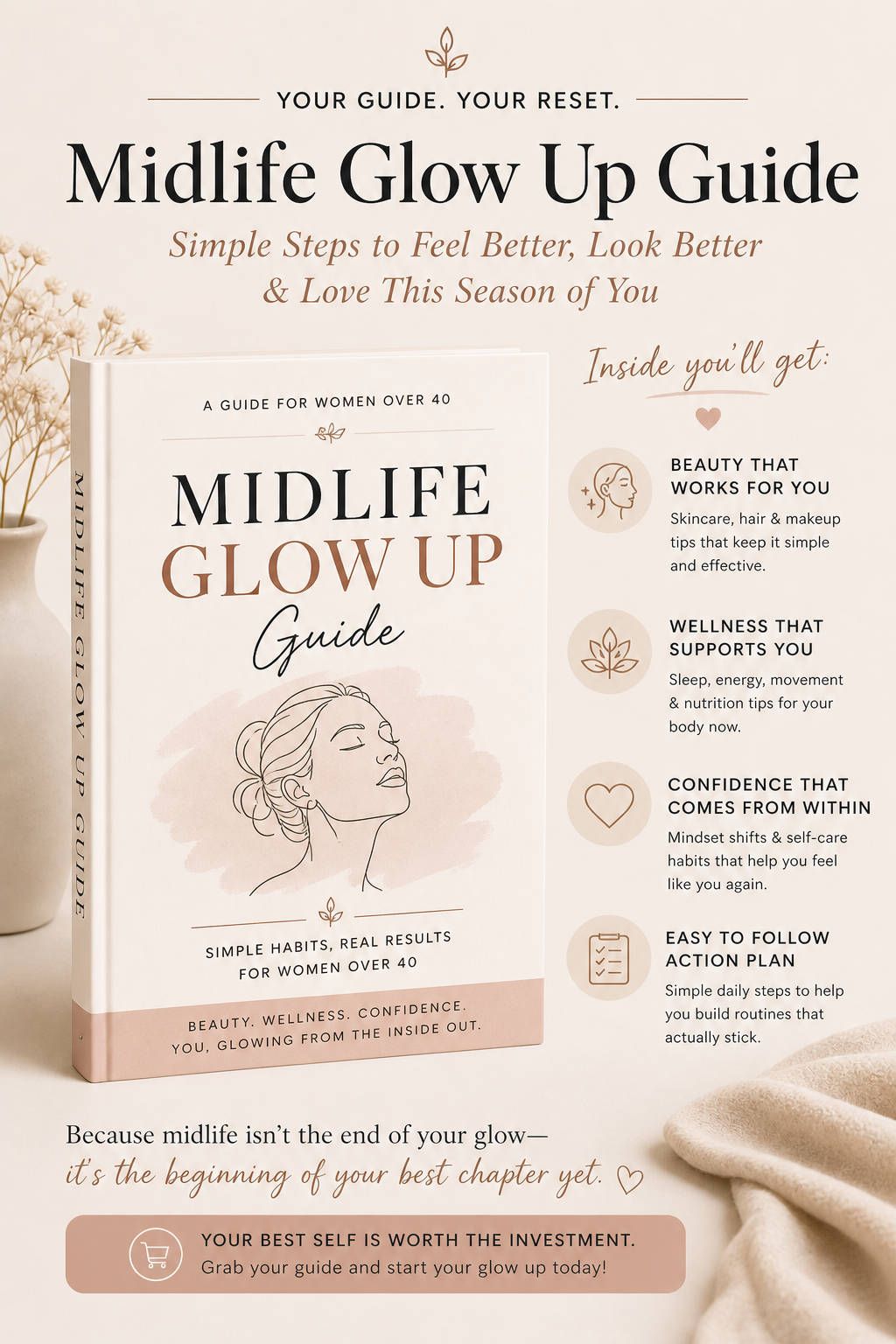
You'll save more than the price of the guide on the first round of supplements you stop buying.
What to stop buying immediately
This is the part most blogs skip because it's bad for affiliate revenue. I don't care. Here's what to throw out.
"Hormone balance" blends
Almost always a small dose of magnesium plus a small dose of an adaptogen plus a premium for the branding. Buy magnesium glycinate and an adaptogen separately if you want them. You'll pay half the price for higher doses.
Greens powders
The expensive ones taste like grass and the cheap ones taste like grass with extra fillers. Eat actual vegetables. If you genuinely can't, a basic fiber supplement does more for your gut than a $90 greens powder.
Mega-dose biotin gummies
Biotin deficiency is rare. Most people taking biotin for hair are wasting money — and high-dose biotin can interfere with thyroid blood tests and give you false readings. Just take a B-complex.
Detox or cleanse supplements
Your liver and kidneys detox you for free, around the clock, with no help needed. "Detox tea" is usually laxatives plus marketing. "Liver cleanse" is usually nothing.
Stimulant-based fat burners
These are bad for women in midlife specifically. Your cortisol is already on the higher end during perimenopause. Adding caffeine and stimulants on top of it makes sleep worse, weight regulation worse, and anxiety worse. Strength training and protein move the needle. Pills don't.
"Anti-aging" or "longevity" blends
Marketing. The actual things that age you slower — sleep, strength training, protein, vitamin D, omega-3s, sun protection — are not in a $99 bottle.
Multivitamins (controversial take)
Most multivitamins are too low-dose to be useful for the things you actually need (vitamin D, magnesium) and too high-dose for the things that can build up to harmful levels (iron, vitamin A). Targeted supplements outperform a multivitamin for almost every adult woman.
How to actually build a supplement routine
If you're starting from scratch, here's the simplest version:
Morning, with breakfast:
- Vitamin D3 + K2
- B-complex
- Omega-3
- Collagen peptides (in coffee or smoothie)
Evening, before bed:
That's it. Five supplements. Total cost from a quality brand: usually $40–$60 a month. Compare that to whatever you're spending now.
If you want to add a probiotic, take it in the morning on an empty stomach, 30 minutes before food.
Don't add anything else until you've been on this stack for 8 weeks and have a clear sense of what's working.
What to track to know if it's working
Supplements aren't magic. They support — they don't transform overnight. The way to tell if your routine is actually working is to track how you feel.
For 30 days, log:
- Sleep quality (1–5)
- Energy (1–5)
- Mood (1–5)
- Skin clarity / hair / nails (notes weekly)
- Any symptoms that come or go
After 30 days of a consistent routine, look at the patterns. If most days are 4s and 5s, your stack is working. If most days are 2s and 3s, something is missing — and now you have data to take to a doctor.
The tracker I built has a daily log that maps to all of this. If you've been thinking about getting it anyway, this is one more reason to.
The Doctor's Appointment Tracker
30 days of symptoms, sleep, mood, and energy — laid out in a fillable PDF that takes two minutes a day. Designed to spot patterns supplements alone can't fix.
Take a Look at the Tracker ($29) →The bottom line
The best supplements for women over 40 aren't expensive, aren't trendy, and aren't sold by Instagram influencers in pretty packaging. They're boring, well-studied, and they work.
Magnesium glycinate. Vitamin D3 + K2. Omega-3. Collagen peptides. B-complex. Probiotics if you need them.
That's the list. Stop buying everything else.
You'll feel better. You'll spend less. And you'll have actual money left over for things that move the needle — like sleep, strength training, and the occasional thing that actually feels like self-care.
Boring beats heroic. Every. Single. Time.

Read next: 5 Signs of Perimenopause Most Women Miss in Their 30s and 40s — if you're here for the supplements, the bigger picture is in this one.
Disclaimer: This post is for informational purposes only and isn't medical advice. Always consult your healthcare provider before starting any new supplement, especially if you take medications or have a medical condition.