This post contains affiliate links, which means I may earn a small commission at no cost to you if you purchase through them. I only recommend products I genuinely use and believe in. Nothing in this post is medical advice — always check with your doctor about persistent symptoms.
It's 3:14 a.m.
You're wide awake. You're hot — not warm, hot — and your heart is going faster than it should be. Your brain is already running through everything you forgot to do yesterday and everything you have to do tomorrow. You roll over. You check the clock. You try to slow your breathing. You don't fall back asleep until 5:30, and your alarm goes off at 6:15.
This has been happening for weeks. Maybe months. Maybe longer.
And every time you mention it to someone, the answer is the same: "You should try going to bed earlier." Or "Cut out caffeine." Or "It's probably just stress."
It's not. If you're a woman in your late 30s or 40s and you're waking up at 3 a.m. — wired, hot, unable to fall back asleep — there's a very specific reason it's happening. It's not random. It's not stress. It's not a personal failure to "wind down."
It's perimenopause. And there's actually a lot you can do about it.
Why 3 a.m. specifically — the science nobody explains
Here's what's happening inside your body around 3 a.m. that almost nobody bothers to tell you:
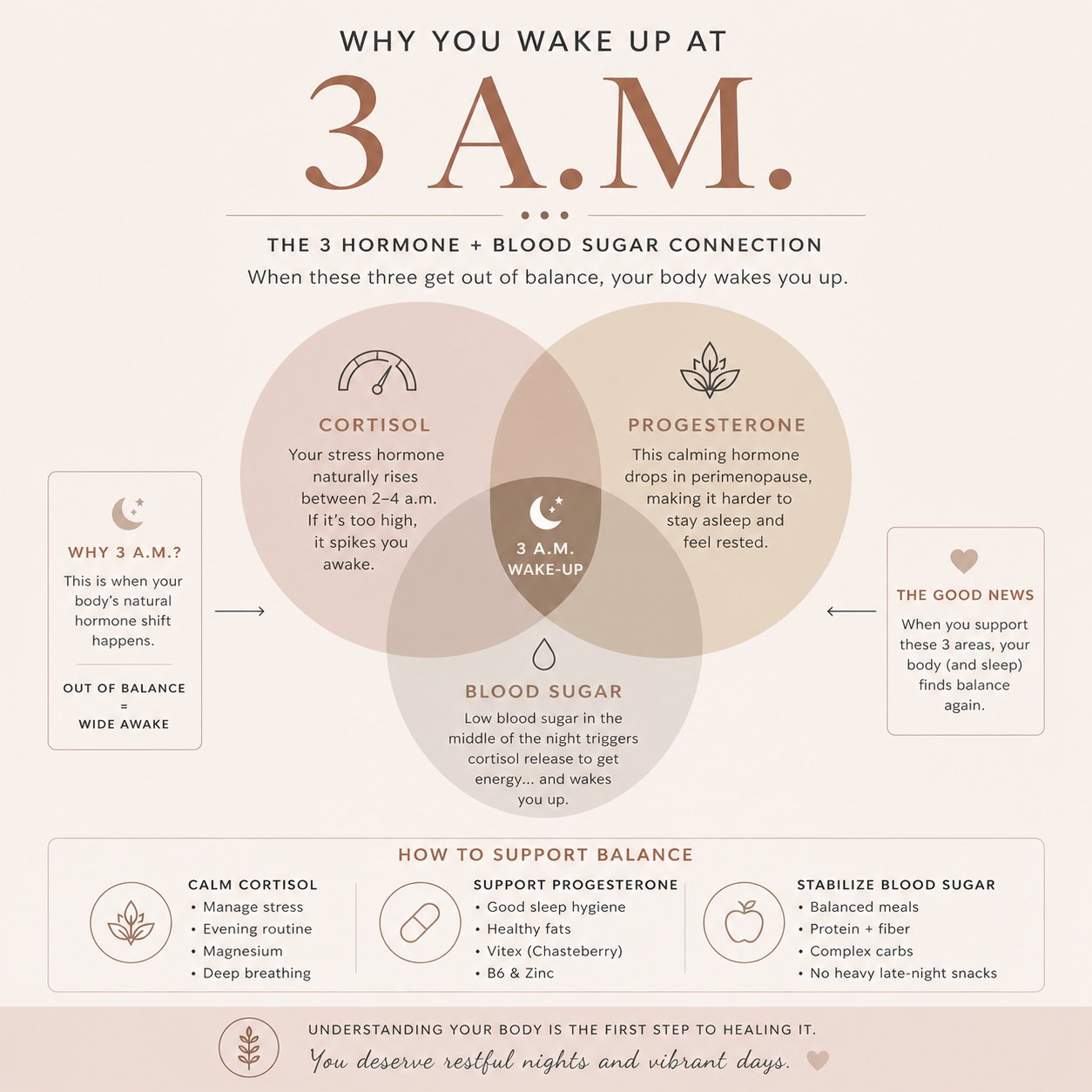
Cortisol starts rising in the early morning hours. Cortisol is your stress hormone, and in a healthy 25-year-old, it rises gradually starting around 4-5 a.m. to wake you up gently. That's normal. That's how it's supposed to work.
In perimenopause, that cortisol curve gets pulled earlier and gets steeper. Instead of a gentle rise at 5 a.m., you get a sharp spike at 2 or 3 a.m. — the kind that fires off your nervous system, raises your body temperature, and slams you awake mid-dream.
Progesterone is the hormone that normally cushions you against this. Progesterone is sedating, calming, sleep-supportive. It's also one of the first hormones to start dropping in perimenopause, often years before estrogen does. So you lose your cushion against the cortisol spike at the same time the spike is getting more intense.
Add a third factor: blood sugar. When estrogen and progesterone shift, your insulin sensitivity changes too. If you ate dinner at 7 p.m. and your blood sugar drops at 2 a.m., your body releases adrenaline to bring it back up. That adrenaline release happens to land in the same window as your cortisol surge. Now you've got two hormones telling your body it's time to be awake.
That's why it's 3 a.m. specifically. Not 1 a.m. Not 5 a.m. The 3 a.m. wake-up is the signature timing of the cortisol-progesterone-blood sugar pile-up that defines perimenopausal sleep disruption.
You're not crazy. You're not just stressed. Your hormones are doing exactly what hormones do during this transition, and your sleep is paying the price.
What it usually looks like (and what makes it worse)
If you're nodding along, you've probably already noticed that the 3 a.m. wake-up doesn't show up randomly. It shows up in patterns.
Most women find it gets worse:
- The week before their period
- The night after a glass of wine, even just one
- The night after a high-sugar dinner or dessert
- The night after a stressful day
- During the summer or in a warm bedroom
- When sleeping next to a partner who runs warm
It often comes with:
- Night sweats severe enough to need a change of pajamas
- A racing heart that feels like anxiety but isn't really anxiety
- Vivid, weird dreams right before you wake up
- An immediate cascade of intrusive thoughts about money, kids, work, marriage
- A complete inability to fall back asleep, even when you're exhausted
If most of that sounds familiar, you're in the right post.
Wondering if your sleep is the only sign?
The 3 a.m. wake-up is rarely the only thing. Most women have 2-3 other early signs of perimenopause showing up too. My free guide You're Not Too Young: 5 Early Signs of Perimenopause Most Doctors Miss walks you through the rest in 3 minutes.
Send Me the Free Guide →What actually helps (in order of impact)
I'm going to be honest with you: there's no single fix. There's a stack of small changes that add up. Most women see real improvement within 30-60 days of stacking them. Don't try all of these at once. Pick two and start.
1. Magnesium glycinate at bedtime
If I could only recommend one thing, this is it.
Magnesium is involved in over 300 processes in your body, including the ones that regulate sleep, calm the nervous system, and support progesterone production. Most women in midlife are deficient in it, and most don't know.
Specifically magnesium glycinate. Not magnesium oxide (badly absorbed), not magnesium citrate (more for digestion), not "magnesium" with no second word (usually oxide).
Dose range: 200-400 mg, 30-60 minutes before bed. Start at 200 mg and see how you feel.
Most women notice a difference within a week. Some notice it the first night.
2. Stop drinking alcohol within 3 hours of bed (or stop entirely for 30 days)
This is the one nobody wants to hear.
Even one glass of wine with dinner can wreck your 3 a.m. window. Alcohol disrupts the second half of your sleep cycle — the part where your body is trying to repair hormones and stabilize cortisol. You fall asleep fine. You crash at 2:30. You're wide awake at 3.
I'm not telling you to quit drinking. I'm telling you to test it. Try 30 days without any alcohol within 3 hours of bed and see what happens to your sleep. If it changes things — and it almost certainly will — you'll have data to make the next decision with.
3. Eat protein and fiber at dinner (and skip the late dessert)
This is the blood sugar piece.
If you eat a low-protein, high-carb dinner — pasta, rice, bread, dessert — your blood sugar spikes, then crashes around 2-3 a.m. The crash triggers an adrenaline release that wakes you up.
Protein and fiber slow that curve. A dinner with 30+ grams of protein, vegetables, and a small amount of healthy fat keeps your blood sugar more stable through the night.
Skip the late dessert. Especially the kind that pairs with wine. Your 3 a.m. self will thank you.
4. Cool the bedroom — colder than you think
Your core body temperature has to drop in order to fall into deep sleep and stay there. In perimenopause, your thermoregulation is already off. A bedroom that's 70°F is going to feel like 78°F by 3 a.m. when you're hormonally hot.
Aim for 65-68°F. Use breathable bedding — cotton or linen, not synthetics. Consider a cooling mattress pad if you can swing it. Sleep with one less blanket than you think you need.
The night sweats almost always get better when the room is cooler. Not gone — better.
5. Track your sleep for 30 days
This is the move that connects all of it.
If you don't know what your sleep is actually doing — how many nights you're waking at 3 a.m., what was happening on the nights you slept through, what made it worse, what made it better — you can't make targeted changes.
Tracking gives you back control. It also gives you the data your doctor needs if you decide to bring this up at an appointment (and you should).
You don't need an app. A simple log with the time you went to bed, the time you woke up, any night wake-ups, and one note about the day before is enough.
(I built one — more on that in a minute.)
6. Stop scrolling when you wake up
This one is small but it matters.
When you wake up at 3 a.m. and immediately grab your phone, three things happen: the blue light suppresses melatonin, your brain gets a hit of dopamine that tells it to stay alert, and you fall down a content hole that makes falling back asleep nearly impossible.
If you wake up, don't reach for it. Lie in the dark. Box breathe — 4 seconds in, 4 hold, 4 out, 4 hold. Repeat ten times. If you're still awake after 20 minutes, get up, go sit in dim light, read something boring, and try again in 30 minutes.
7. Talk to your doctor about progesterone
This is a longer conversation than this post can hold, and it's not a fit for everyone. But for some women, replacing the progesterone their body has stopped producing reliably is the thing that changes everything about their sleep.
Bioidentical progesterone (often prescribed as oral micronized progesterone) is the form most commonly discussed for perimenopausal sleep support. It's not for everyone. It's worth a real conversation with a doctor who specializes in midlife hormone health.
If you don't know how to have that conversation, the next section is for you.
How to actually bring this up at the doctor's office
If you want to talk to your doctor about your sleep — and especially about whether something like progesterone might help — you need to walk in with data. Not vibes. Data.
Specifically: how many nights you woke at 3 a.m. in the last 30 days. What time exactly. Whether it came with night sweats. What your cycle was doing. What you ate, drank, or did the day before.
That level of specificity changes the conversation. "I haven't been sleeping well" gets you a sleep hygiene pamphlet. "I've woken up at 2:45 to 3:30 a.m. on 22 of the last 30 nights, almost always with night sweats, almost always the week before my period" gets you an actual conversation.
That's why I built The Doctor's Appointment Tracker.
The Doctor's Appointment Tracker
30-day fillable PDF with a daily log for sleep, period, mood, energy, and symptoms — using a shorthand key so it takes two minutes a day. Pattern-spotting guide, plus the question sheet with the exact things to ask. $29. Yours forever.
Take a Look at the Tracker →
If 3 a.m. is your new normal, this is the homework that finally gets you somewhere.
The bottom line
Waking up at 3 a.m. in perimenopause isn't random, and it isn't a personal failure. It's the predictable result of a cortisol spike, a progesterone drop, and a blood sugar crash all landing in the same window — at the exact moment your body is the worst at handling them.
The fixes aren't glamorous. Magnesium. Less wine. Protein at dinner. A colder bedroom. Tracking. Maybe progesterone, depending on what your doctor says.
Boring beats heroic. Every. Single. Time.
You don't need to do everything. Pick two. Start tonight.
You'll sleep through the night again. It just takes the right small changes, repeated long enough for your body to catch up.

Read next: 5 Signs of Perimenopause Most Women Miss in Their 30s and 40s — if 3 a.m. is one of yours, the others might be too.
Disclaimer: This post is for informational purposes only and isn't medical advice. Always work with a qualified healthcare provider for diagnosis and treatment.