
This post contains affiliate links, which means I may earn a small commission at no cost to you if you purchase through them. I only recommend products I genuinely use and believe in. Nothing in this post is medical advice — always check with your doctor about persistent symptoms.
You've been telling your doctor something is wrong for months. Maybe longer.
You list the symptoms — the night sweats, the fatigue, the weird periods, the brain fog. They nod. They run a basic blood panel. A week later, you get the email.
"Your labs are fine."
You walk out of the office feeling like you wasted everyone's time, including yours. You drive home wondering if you're imagining it. You're not. The problem isn't that nothing is happening. The problem is that a 15-minute appointment and a single blood draw can't see what your body is actually doing.
The patterns can.
This is what to track for 30 days before your next appointment so you finally walk in with proof — not vague frustration. If you've been Googling perimenopause symptoms, hormone tracking, or what to track before your doctor's appointment, this is the answer.
Why a single doctor's visit can't see what's wrong
Here's something nobody explains to you: perimenopause symptoms shift across days, weeks, and entire cycles. Your hormone levels on a random Tuesday morning don't tell anyone what your body has been doing for the last month.
A blood test catches one moment in time. Your symptoms are happening across hundreds of moments.
The night sweats happen on specific days. The brain fog clusters with certain symptoms. The mood shifts map to your cycle. The sleep gets worse the week before your period. None of that shows up in a lab result.
That's why doctors miss it. Not because they don't care — most of them do — but because they only see the snapshot. You're the only one who can see the pattern.
If you want to be taken seriously, you have to bring the pattern with you.
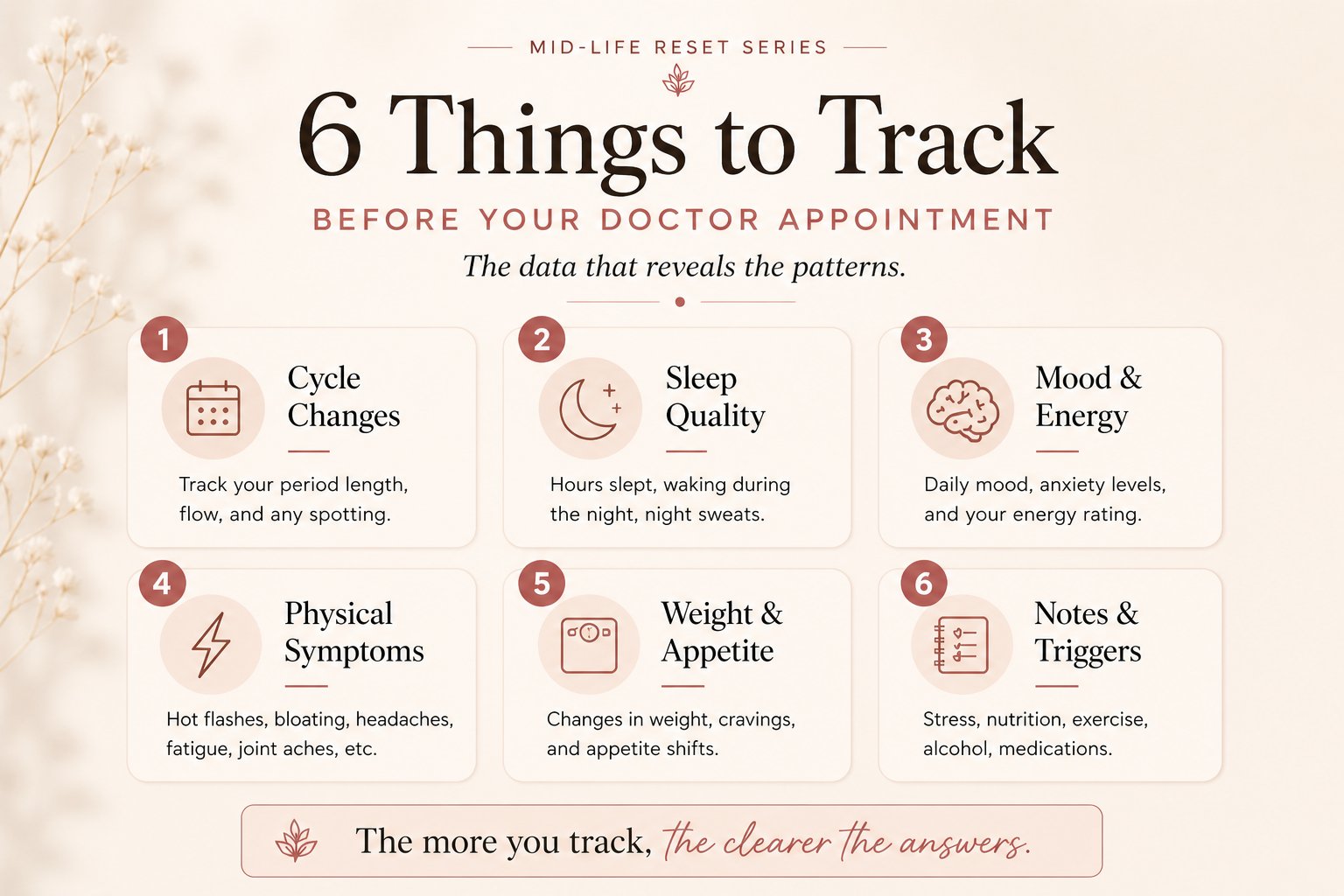
What to track for 30 days
You don't need a fancy app. You don't need to write essays. You need a simple log you can fill in two minutes a day, ideally on paper or in a basic PDF you can print and bring with you.
Here's what to track:
1. Your period
Even if it's irregular. Especially if it's irregular. Track the start date, end date, and flow level — light, medium, heavy, or just spotting. If you skip a month, write "none." If your period shows up at week three for no reason, write that down.
Why it matters: changes in cycle length, flow, and predictability are some of the strongest indicators of perimenopause. Your doctor needs to see whether your cycles are shifting and how.
2. Your sleep
Two numbers. How many hours you slept, and whether you woke up in the middle of the night. If you woke up at 3 a.m. drenched, write "3 a.m. + night sweats." If you slept seven hours but feel like you slept four, write that down too.
Why it matters: sleep disruption is one of the earliest and most predictive perimenopause symptoms. The 3 a.m. wake-up specifically is connected to the cortisol-progesterone shift, and seeing it happen most nights for 30 days tells your doctor something specific.
3. Your mood
Rate it on a scale of 1 to 5. One is rough. Five is good. Don't write paragraphs. Just the number. Add one word if you want — "anxious," "snappy," "fine."
Why it matters: mood patterns almost always cluster around specific cycle days. Seeing that you scored 1-2 on days 22-26 every cycle is way more useful than "I've been feeling off."
4. Your energy
Same scale. One is exhausted. Five is energized. Track this in the afternoon when the post-lunch crash usually hits — that's the most diagnostic time of day for hormone-related fatigue.
Why it matters: energy patterns reveal whether you're dealing with hormonal fatigue, sleep debt, or both. Your doctor can't tell the difference without 30 days of data.
5. Your symptoms
This is where most people give up — too many symptoms, too much writing. The fix is shorthand.
Use 2-letter codes for the symptoms that show up most often after 40:
- HF — hot flash
- NS — night sweats
- BF — brain fog
- AX — anxiety
- HD — headache
- JA — joint aches
- IR — irritability
- BL — bloating
You can log a whole day's symptoms in five characters. "HF, NS, BF" takes ten seconds to write.
Why it matters: tracking symptom frequency lets you walk in and say "I've had night sweats 22 of the last 30 nights, almost always between 2 and 4 a.m." That's not a vague complaint. That's data.
6. Notes (optional)
One line. Anything notable. Stress, alcohol, a big meal, a fight, a great workout, a missed dose of something.
Why it matters: this is where the trigger patterns hide. You'll start noticing things like "I never sleep well after wine" or "my mood drops the day after stressful work meetings." Your doctor doesn't need this — but you do.
Not sure if you're dealing with perimenopause yet?
Before you spend 30 days tracking, it helps to know what you're watching for. My free guide You're Not Too Young: 5 Early Signs of Perimenopause Most Doctors Miss walks you through it in 3 minutes.
Send Me the Free Guide →Want a tracker that's already built?
If you'd rather not build your own tracker from scratch, I made one. It's a 30-day fillable PDF with all of the above already laid out — period, mood, sleep, energy, symptoms, notes — plus a shorthand key, a pattern-spotting guide, and a question sheet to bring to your appointment.
It's called The Doctor's Appointment Tracker. $29. One-time. Yours forever.
The Doctor's Appointment Tracker
30 days of symptoms. One appointment that finally goes somewhere. Daily log, shorthand key, pattern-spotting guide, and the question sheet to bring with you.
Take a Look at the Tracker →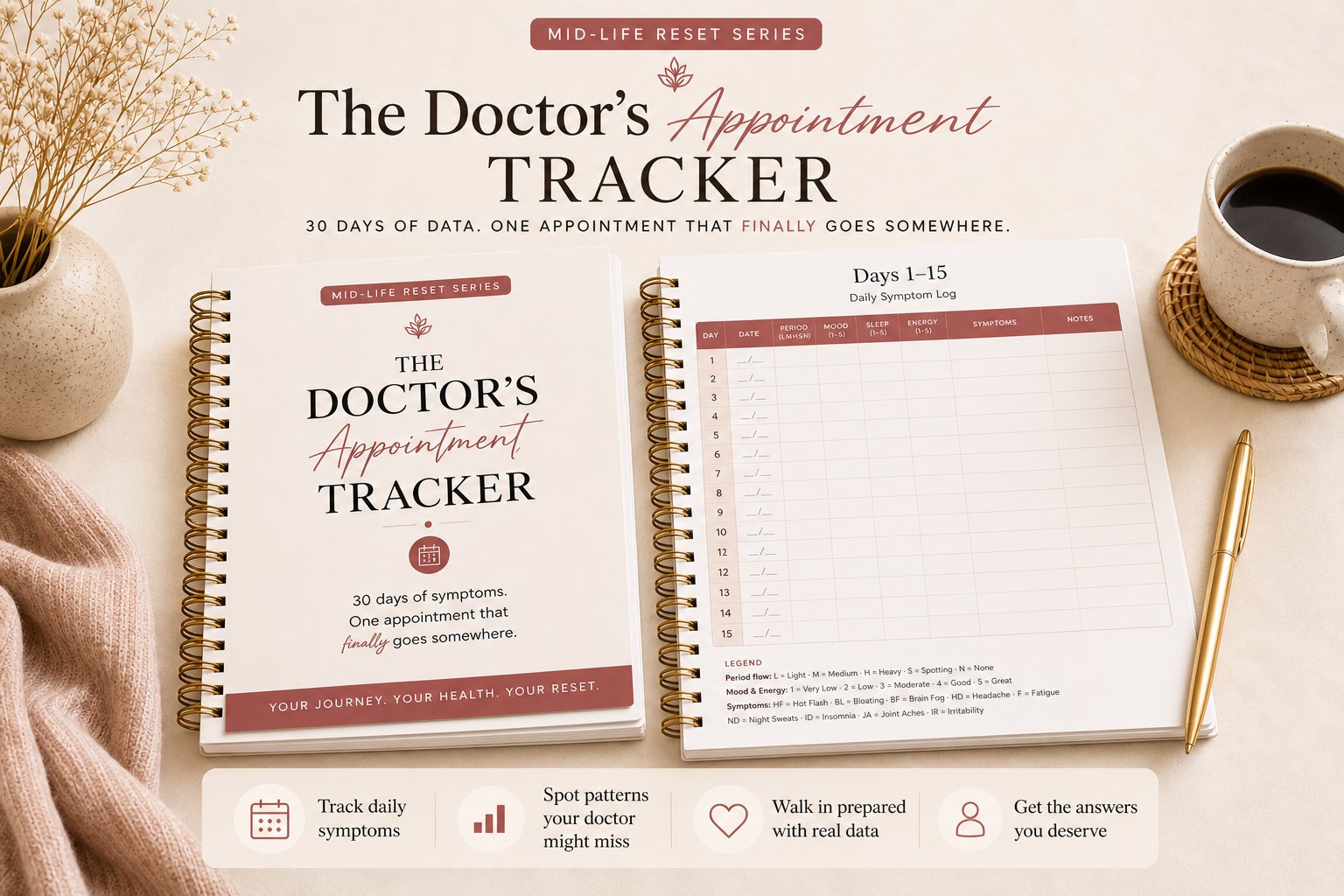
How to read your data after 30 days
Tracking for 30 days is half the work. Reading the data is the other half.
When you sit down with your log at the end of the month, look for three things:
Cyclical patterns
Symptoms that show up on the same days of your cycle, every cycle. Hot flashes the week before your period. Mood crashes on day 24. Brain fog during ovulation.
Cyclical patterns are the strongest signal that what you're dealing with is hormonal — not random, not stress, not "just life." Your doctor needs to know which cycle days are affected.
Symptom clusters
Symptoms that show up together. Night sweats + brain fog + irritability often hit on the same days. Joint aches + fatigue often pair. Headaches + mood shifts often pair.
Clusters tell your doctor that what you're describing isn't five separate problems — it's one connected pattern with one underlying cause. That changes the conversation.
Trends
Symptoms getting worse or better across the month. Sleep getting steadily worse. Hot flashes increasing in frequency. Energy declining week over week.
Direction matters because it changes the urgency. A symptom that's getting steadily worse over 30 days is different from one that's been the same for a year.
What to bring to your appointment
When you walk in, you don't read your tracker page by page. You walk in with three things:
- A summary box. Top 3 symptoms by frequency. Top 3 by severity. Cycle days most affected. What seems to make it worse. What seems to help.
- The tracker itself, in case the doctor wants to see the daily detail.
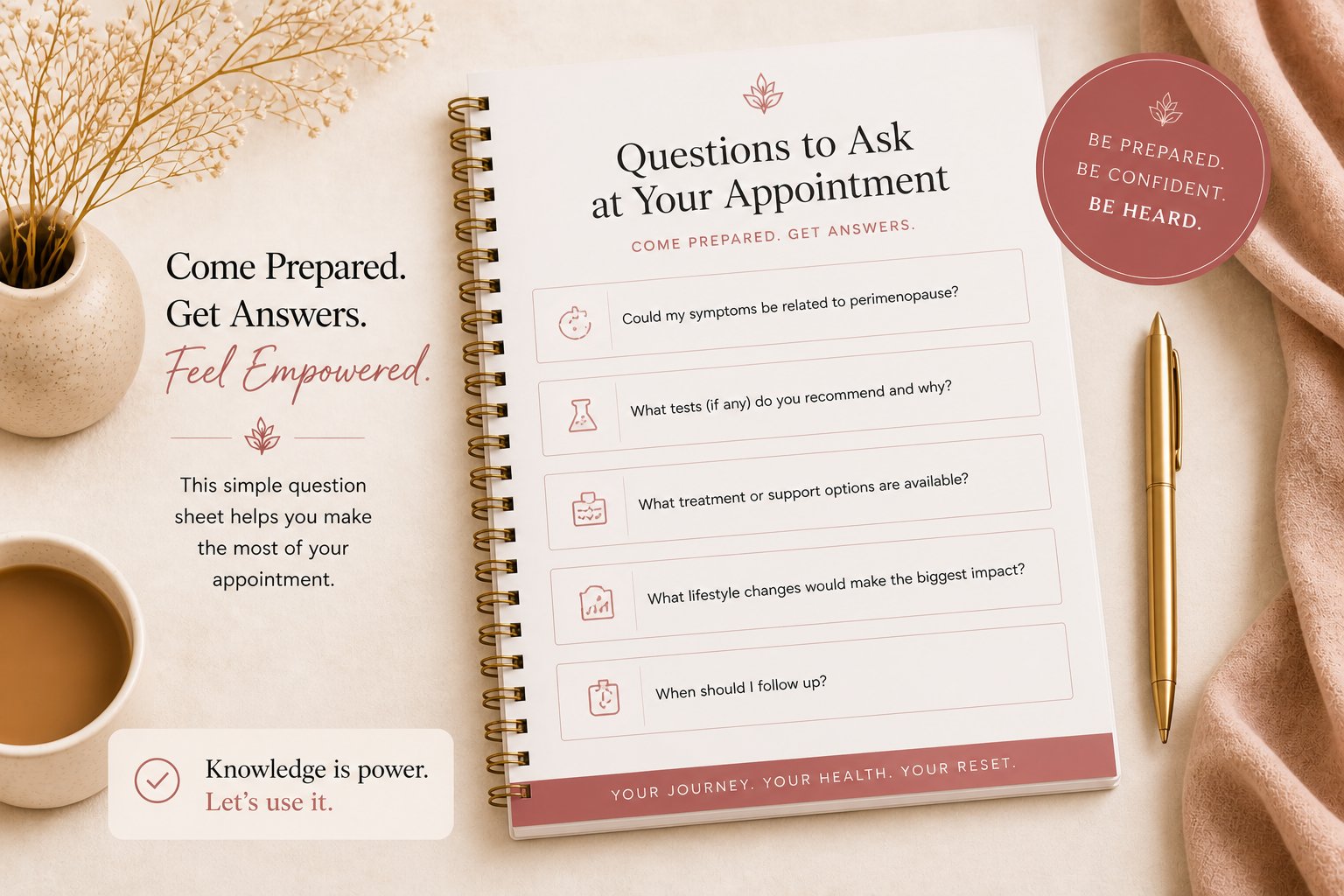
- A list of questions. Don't trust yourself to remember them in the moment. Write them down.
Open the appointment with this exact line:
For the last 30 days, I've been tracking my symptoms. I have data on what's been happening. I'd like to understand what's going on and what to do next.
That sentence changes the entire dynamic. You're not asking the doctor to figure it out from scratch. You're handing them the homework, already done.
Questions worth asking
Once you've laid out the patterns, here's what to ask:
- Based on these patterns, could this be perimenopause?
- What hormone levels would you check?
- Can we run a thyroid panel as well?
- What's a realistic timeline to start feeling better?
- What lifestyle changes do you recommend?
- Are there supplements you'd recommend or avoid?
- If this isn't hormonal, what else could explain it?
- When should I come back, and what should I track between now and then?
If your doctor dismisses your tracking, asks for "just one more blood test," or tells you you're too young — ask for the actual numbers, request a referral, or get a second opinion. You're allowed to.
The whole point of bringing data is that you're no longer working off vague feelings. You have evidence. Use it.
What changes once you start tracking
Most women I talk to say the same thing after their first month of tracking: "I had no idea how clear the patterns would get."
Tracking does three things at once:
It validates what you're feeling. When you see that the night sweats happened 22 nights out of 30, you stop wondering if you're being dramatic. You're not.
It gives your doctor something to work with. A 30-day pattern is the difference between "I think I'm having a hard time" and "here's exactly what's been happening — what do you think?"
It gives you back some control. Perimenopause feels like a thing happening to you. Tracking is the first step in turning it into something you can actually navigate.
The bottom line
If you're a woman over 40 — or 35, honestly — and your appointments keep ending with "your labs are fine," the problem isn't your symptoms. It's the data.
Bring 30 days of data. Bring a question sheet. Open with a clear line. Don't accept "you're too young."
You're not falling apart. You're shifting. You just need someone to actually look at the pattern.
You don't need to do everything. You just need to start watching.
Read next: 5 Signs of Perimenopause Most Women Miss in Their 30s and 40s — if you're not sure perimenopause is what you're dealing with, start here.
Disclaimer: This post is for informational purposes only and isn't medical advice. Always work with a qualified healthcare provider for diagnosis and treatment.