
This post contains affiliate links, which means I may earn a small commission at no cost to you if you purchase through them. I only recommend products I genuinely use and believe in. Nothing in this post is medical advice — always check with your doctor about persistent symptoms.
You sat in the chair. You listed the symptoms. You watched them nod, type, smile politely, and order a basic blood panel.
A few days later, the email came: "Your labs are fine. Let us know if symptoms persist."
You stared at your phone. You read it twice. And somewhere underneath the frustration, you felt a tiny voice say: Maybe I'm imagining this.
You're not.
If a doctor dismissed your perimenopause symptoms, told you your labs were normal, or — the classic — said you were "a little young for that," this is for you. Because what just happened isn't a sign that nothing is wrong. It's a sign that the system is built to miss what you're dealing with, and you're going to have to get a little louder.
Let's talk about how.
Why your doctor said your labs are fine when you know something isn't
Here's the thing nobody tells you about perimenopause and bloodwork.
Hormones don't sit still. Estrogen, progesterone, FSH, and cortisol all move — sometimes by the hour, definitely by the day, dramatically by the cycle phase. A blood draw at 9 a.m. on a Tuesday catches one frame of a movie that's been running for years.
If your levels happen to land in the "normal" range that morning, your labs come back fine — even if your hormones are crashing and surging in a pattern that's wrecking your sleep, your mood, and your energy.
That's not your doctor missing something out of negligence. That's the limitation of how perimenopause is diagnosed in most clinical settings. The standard panel was built for women whose hormones move slowly and predictably — not for the chaos of perimenopause, where the whole point is that things stop being predictable.
So when you hear "your labs are fine," what's usually being said is: "Your one-moment-in-time snapshot didn't show anything outside the reference range."
That's not the same as "nothing is happening."
You know it isn't.
Why "you're a little young for that" is almost always wrong
Perimenopause can start in your mid-30s.
The average age it starts is around 40-45, but the range is wide. Some women start showing symptoms at 35. A small percentage start in their late 20s.
If you're 38 and your doctor says you're "too young for perimenopause," they're working off an outdated assumption that perimenopause starts at 47 and ends at menopause around 51. That's not the reality of the data, and it's not the reality of millions of women who are dealing with this in their late 30s right now.
The phrase "you're too young" usually means one of three things:
- The doctor was trained on outdated guidelines.
- They haven't had recent continuing education on perimenopause.
- They're pattern-matching to other 38-year-olds with similar complaints who turned out to have something else.
None of those are reasons for you to walk away and accept that nothing is wrong. They're reasons for you to push harder, ask for the right tests, or find a different provider.
The 5 things to say when your doctor dismisses you
These are the lines that change the conversation. Practice them out loud before your next appointment. I'm not joking — it's easier to say a hard sentence when you've heard your own voice say it once.
1. "I've been tracking my symptoms for 30 days. Can I show you the patterns?"
This is the most powerful sentence you can open with, because it shifts the dynamic immediately. You're no longer a patient describing vague symptoms. You're a patient with data.
Most doctors, even the dismissive ones, respond differently to data than they do to feelings. It's not fair, but it's true. Use it.
If you don't have 30 days of tracking yet, that's the first homework. (More on that in a minute.)
2. "What hormone levels would you check, and at what point in my cycle?"
Most basic blood panels don't include the hormones that matter for perimenopause. Asking specifically signals that you've done your reading.
The hormones worth asking about: FSH (follicle-stimulating hormone), estradiol (E2), progesterone, and a thyroid panel (TSH, free T3, free T4). Vitamin D, ferritin, and B12 are also worth requesting because they affect energy, mood, and hair — and they're often low in midlife women.
Cycle timing matters too. Progesterone is checked around day 21 of your cycle. Estradiol and FSH are usually checked early in your cycle. If your doctor wants to run a panel, ask when in your cycle they want you to come in.
3. "If this isn't perimenopause, what else could explain these symptoms?"
This is the question that exposes whether your doctor is actually engaging with your case or just dismissing it.
If they have a real alternative — thyroid, anemia, autoimmune, depression — fine. Run those tests. But if their answer is "probably stress" or "this happens as we get older," that's not a diagnosis. That's a brush-off.
Push for specifics. "What specifically would you want to rule out, and how?"
4. "Can I get the actual numbers from my labs?"
When a doctor says your labs are fine, ask for the printout — or better, log into your patient portal and pull them yourself.
Here's why: "fine" is relative. A TSH of 4.0 might be technically within range, but plenty of women feel terrible until it drops below 2.5. Estradiol that's "normal for your age" might be normal for a 60-year-old, not a 41-year-old. You can't have a real conversation about your numbers if you don't know your numbers.
You're entitled to your own labs. Ask.
5. "I'd like a referral to a menopause specialist or a women's health clinic."
If you've tracked, asked the right questions, gotten the labs, and your doctor still isn't engaging — it's time to go around them.
Menopause specialists exist. Women's health clinics exist. Some primary care doctors have additional training in midlife hormone health. The Menopause Society maintains a directory of certified practitioners, which is worth a search.
Asking for a referral isn't being difficult. It's being efficient. You don't have time to spend another year being dismissed.
Not sure if perimenopause is even on your doctor's radar?
If "you're too young" is the answer you keep getting, this free guide will help you walk in with the right vocabulary. You're Not Too Young: 5 Early Signs of Perimenopause Most Doctors Miss — read it in 3 minutes.
Send Me the Free Guide →What to do if you get dismissed anyway
Some doctors will still brush you off no matter how prepared you are. That's not a sign you did something wrong. It's a sign that this provider isn't the right fit for what you're navigating.
Here's what to do next:
Document the appointment. Write down what you said, what they said, and what they did or didn't order. This matters if you eventually file a complaint or switch providers — and it matters for your own clarity.
Ask for the dismissal in writing. "Just so I have it for my records, can you note in my chart that you don't think further testing is needed at this time?" Most doctors will reconsider when they're being asked to put it on paper.
Switch providers. This is the hardest one because it feels like starting over. It's not. It's choosing not to spend more years of your life being unheard. There are doctors who take perimenopause seriously. They exist. Find one.
Don't gaslight yourself. This is the one I want to underline. The voice in your head that says "maybe I'm being dramatic" or "maybe it really is just stress" — that voice is what dismissive medicine teaches women to internalize. You're the only person who lives in your body. If something is off, something is off.
The thing that changes everything
Most women who get dismissed at the doctor's office have one thing in common: they walked in with feelings instead of data.
That's not a criticism. It's how most of us were taught to talk about our health. "I haven't been feeling like myself." "My sleep has been bad." "My periods have been weird."
Those sentences are true. They're also incredibly easy for a doctor to brush past in a 15-minute appointment.
What changes the conversation is specificity. "I've had night sweats 22 of the last 30 nights, almost always between 2 and 4 a.m." "My mood drops on days 22-26 of every cycle, every cycle." "I'm averaging 5.5 hours of sleep, broken into 2-3 chunks."
That's a different conversation. That's data the doctor has to engage with.
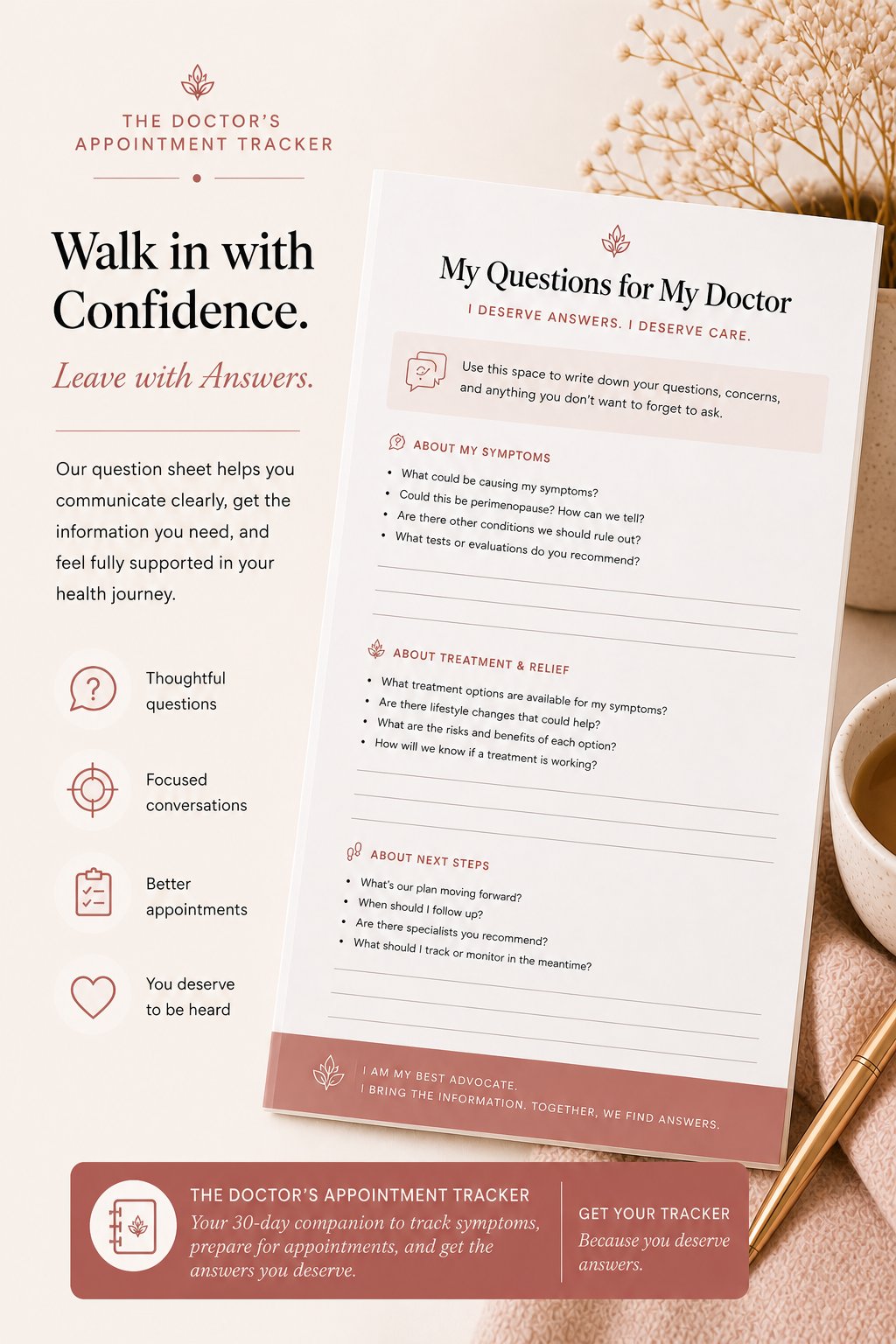
That's why I built The Doctor's Appointment Tracker.
The Doctor's Appointment Tracker
30-day fillable PDF. Daily log, shorthand key, pattern-spotting guide, and a question sheet with the exact things to ask, the labs worth requesting, and what to push back on if you get dismissed. $29. Yours forever.
Take a Look at the Tracker →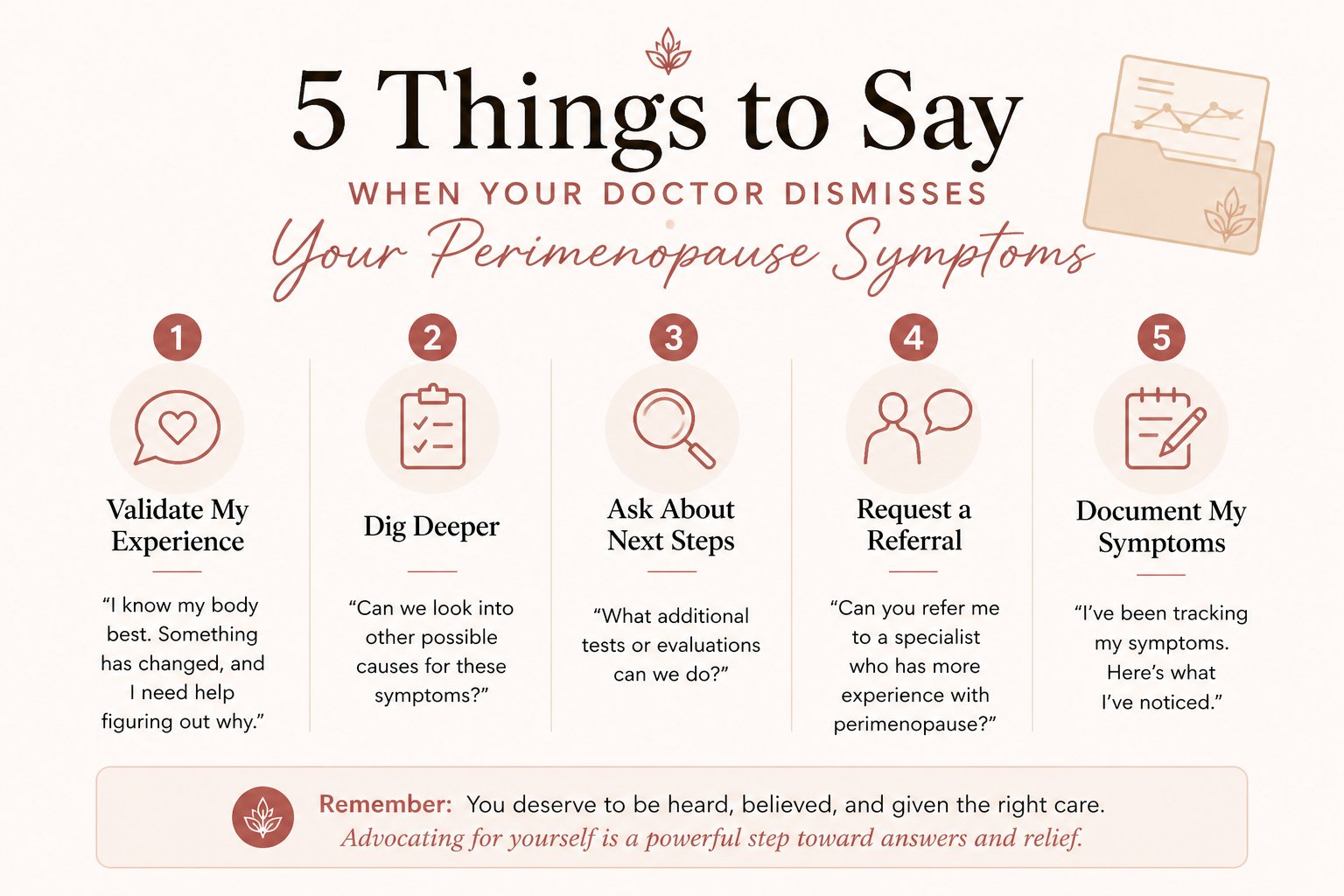
If you've been to the doctor and walked out with "your labs are fine" — this is the homework that changes what happens next time.
You are not the problem
I want to say this directly because I don't think most women hear it enough.
If your doctor dismissed your perimenopause symptoms, that doesn't mean you're imagining things. It doesn't mean you're being dramatic. It doesn't mean you're too young. It doesn't mean you're broken.
It means the system that was supposed to catch this is too narrow, too fast, and too dependent on a 9 a.m. blood test to see what your body has actually been doing.
You're going to have to be louder than you should have to be. You're going to have to bring data instead of feelings. You're going to have to ask questions you shouldn't have to ask.
But once you do, the conversation changes. You stop being dismissed. You start getting answers.
You're not too young. You're not crazy. You're paying attention. That's how this works now.

Read next: What to Track Before Your Next Doctor's Appointment (If You're a Woman Over 40) — exactly what to track for 30 days so you walk in with proof.
Disclaimer: This post is for informational purposes only and isn't medical advice. Always work with a qualified healthcare provider for diagnosis and treatment.